The Real Difference Between eSIMs, Roaming, and Local SIMs
Getting mobile data while traveling used to involve a fairly unpleasant choice: pay your normal carrier an enormous roaming bill or land in another country and immediately begin searching for somewhere selling SIM cards.
By Alex Slavistki on October 9, 2026
Getting mobile data while traveling used to involve a fairly unpleasant choice: pay your normal carrier an enormous roaming bill or land in another country and immediately begin searching for somewhere selling SIM cards.
Now there’s a third option.
eSIMs have made international connectivity significantly easier, but they’ve also added another decision travelers need to make. Should you use your existing plan and roam, buy a travel eSIM before departure, or get a local SIM after arriving?
All three can work.
The best choice depends on where you’re going, how long you’re staying, how much data you need, and how much convenience you’re willing to pay for.
Roaming keeps everything simple
International roaming means continuing to use your normal mobile plan while connected to a partner network abroad.
The biggest advantage is convenience.
You land, turn off airplane mode, and your phone connects. Your normal SIM stays active, your phone number remains the same, and you don’t need to install or replace anything.
For short trips, that simplicity can be worth paying for.
Some mobile providers include roaming in certain countries or offer daily and weekly travel packages at reasonable prices. If your destination is already covered by your plan, roaming may be the obvious choice.
The problem is that roaming prices vary dramatically.
A plan that’s inexpensive in one country can become extremely expensive in another.
Never assume.
Check your provider’s current rates for the exact destination before traveling.
eSIMs remove the physical card
An eSIM performs the basic role of a SIM digitally.
Instead of inserting a small plastic card into your phone, you install a mobile plan electronically.
For travelers, this means you can often purchase data for your destination before leaving home.
You install the eSIM, configure it, and activate the plan when you arrive.
The convenience is difficult to overstate.
There’s no airport kiosk to find, no tiny SIM card to lose, and no need to explain your desired data package through a language barrier.
You can step off the plane with mobile data ready to go.
The major requirement is that your phone must support eSIM technology and be compatible with the provider you’re using.
Check before purchasing.
Travel eSIMs are usually built for convenience
Many travel eSIM companies sell packages covering individual countries, regions, or even large groups of destinations.
This makes them particularly attractive for multi-country trips.
Imagine traveling through five European countries in two weeks.
Instead of buying a new physical SIM each time you cross a border, you may be able to use one regional eSIM throughout the trip.
That simplicity is valuable.
However, travel eSIMs aren’t automatically the cheapest option.
You’re often paying partly for convenience.
A local mobile provider may offer considerably more data for the same amount of money.
For a short vacation, the difference may be irrelevant.
For a three-month stay, it can become significant.
Local SIM cards can offer excellent value
A local SIM means buying service from a mobile provider in the country you’re visiting.
This often provides strong value because you’re effectively becoming a temporary local mobile customer rather than roaming internationally.
Packages may include generous amounts of data, local calls, and a local phone number.
For longer stays, local SIMs can be difficult to beat.
The inconvenience comes at the beginning.
You may need to find an authorized shop, present identification, choose between unfamiliar plans, register the SIM, and replace your existing physical card.
Some countries make this extremely easy.
Others involve more bureaucracy.
If you’re staying for a month, the effort may be worthwhile.
If you’re leaving in 48 hours, probably less so.
Your phone number is an important difference
This is where travelers sometimes get confused.
Using your normal SIM through roaming keeps your existing number functioning normally.
A local physical SIM usually gives you a new local number while it’s installed, unless your phone supports using multiple SIMs simultaneously.
Travel eSIMs vary. Many are data-only, meaning they give you internet access but don’t provide a traditional phone number for normal calls and SMS.
That isn’t necessarily a problem.
WhatsApp, FaceTime, Signal, Messenger, and similar services work through internet data.
But traditional SMS messages can still matter.
Banks, airlines, websites, and other services may send verification codes to your normal phone number.
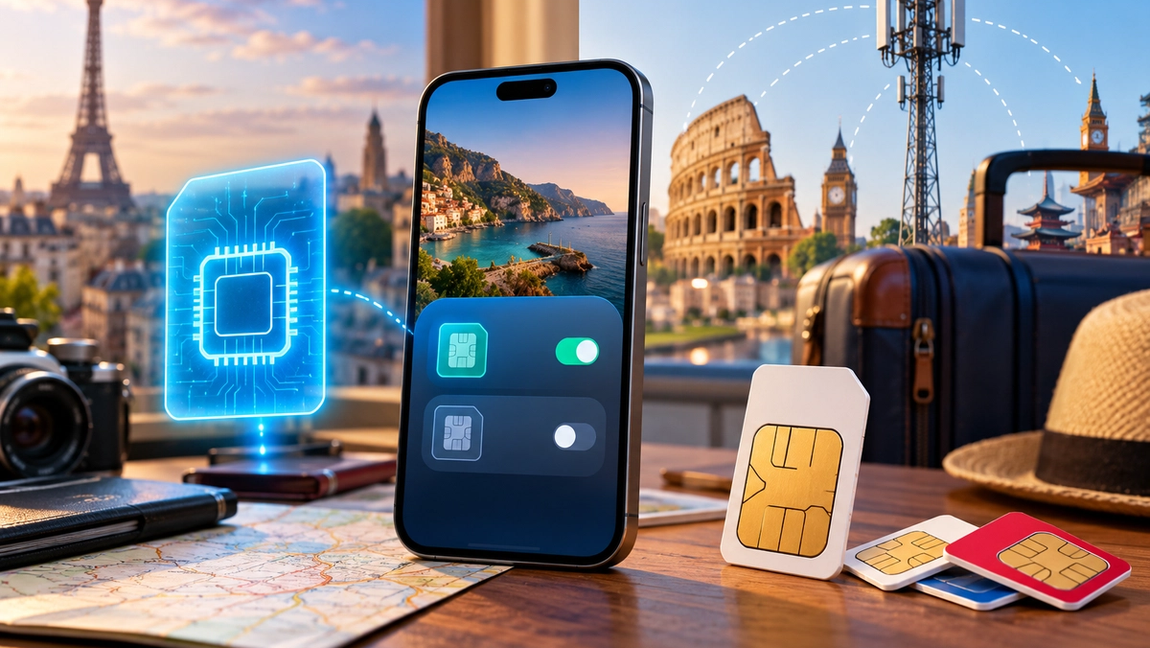
That’s why dual-SIM capability can be so useful.
Dual SIM gives travelers the best of both worlds
Many modern phones can keep two mobile lines available at the same time.
That might mean one physical SIM and one eSIM or multiple eSIM profiles, depending on the device.
This creates a useful travel setup.
Your normal SIM remains available for your regular number and important messages.
Your travel eSIM handles mobile data.
The crucial part is configuring the settings correctly.
You need to tell your phone which line should use cellular data and whether the other line is allowed to roam.
Otherwise, you can accidentally buy a cheap travel eSIM while your phone continues using expensive roaming data from your home provider.
Technology cannot save you from the wrong toggle.
Calls and texts can change the calculation
If you mainly need internet, an eSIM can be ideal.
If you need to make frequent traditional local calls, a local SIM may be more useful.
This can matter when contacting restaurants, hotels, medical services, tour companies, landlords, or businesses that don’t use your preferred messaging apps.
Roaming may also be attractive if your provider includes international calls and texts in its travel package.
Think about what “staying connected” actually means for your trip.
Someone who needs Google Maps and WhatsApp has very different requirements from someone traveling for business who expects frequent traditional phone calls.
Don’t pay for features you won’t use.
But don’t discover halfway through the trip that the feature you need isn’t included.
Data allowances matter more than the headline price
A €5 eSIM isn’t automatically cheaper than a €15 local SIM.
Compare what you’re actually getting.
How much data is included?
How long is the plan valid?
Does it support hotspot or tethering?
Can you top it up?
Does the plan cover every country you’re visiting?
When does the validity period begin?
Does the advertised “unlimited” plan have speed restrictions after a certain amount of usage?
Read the details.
Travel connectivity plans are often marketed around simple numbers, while the limitations are hiding underneath them.
The cheapest package isn’t useful if you burn through it on day two.
Your travel style determines how much data you need
A light user may need surprisingly little mobile data.
Messaging, basic web searches, email, and occasional navigation don’t necessarily consume huge amounts.
Video changes everything.
Streaming, social media, video calls, automatic photo uploads, and hotspot use can consume data quickly.
Before buying a plan, think about your normal behavior.
If you constantly upload videos and watch social media while moving around, don’t buy the smallest package and hope for a personality transformation when you land.
Buy enough data.
Alternatively, configure large uploads and streaming to happen only over Wi-Fi.
Multi-country trips favor flexibility
Traveling through several countries makes the decision more interesting.
Roaming may be easiest if your existing provider covers the entire region.
A regional eSIM can be excellent if it includes every destination on your itinerary.
Buying individual local SIM cards repeatedly usually makes less sense unless you’re spending substantial time in each country.
But always check the exceptions.
A regional package may cover almost every destination on your trip except one.
That one border crossing is where people get caught.
Know what happens before you arrive.
Longer stays often favor local service
The longer you remain somewhere, the more attractive local mobile service becomes.
For a weekend trip, convenience usually matters more than squeezing every possible cent from your data plan.
For a semester abroad, several months of remote work, or an extended stay, local pricing and a local phone number can become much more useful.
At that point, you’re not really solving a travel connectivity problem anymore.
You’re temporarily living somewhere.
A local plan begins to make sense.
So which one should you choose?
For a short trip, start by checking roaming.
If your existing carrier offers affordable coverage at your destination, using it may be the easiest solution.
If roaming is expensive, a travel eSIM is often an excellent next option, particularly when you mainly need data or you’re visiting multiple countries.
For longer stays, heavy data use, or situations where you need a local number, compare local SIM plans.
There is no universal winner.
The mistake is assuming one method is always cheaper.
The best option is the one you understand before landing
Don’t make this decision while standing beside baggage claim with airport Wi-Fi cutting in and out.
Before leaving home, check your phone’s compatibility, roaming rates, expected data use, and destinations.
If you’re using an eSIM, install it in advance when possible.
If you’re buying a local SIM, research which providers operate at your destination and what registration requirements exist.
And whatever option you choose, understand your phone’s mobile data settings.
A €10 eSIM won’t save you money if your €15-per-day roaming line is still running beside it.
Set everything up correctly, download your offline maps, and move on.
Your mobile connection should be one of the least interesting parts of your trip.
That’s usually how you know you’ve chosen well.