How to Take Better Travel Photos with Just Your Phone
Modern phones are remarkably capable. They can handle landscapes, portraits, architecture, food, low light, video, and almost every ordinary travel situation without requiring you to understand complicated camera settings.
By Lila Odin on October 9, 2026
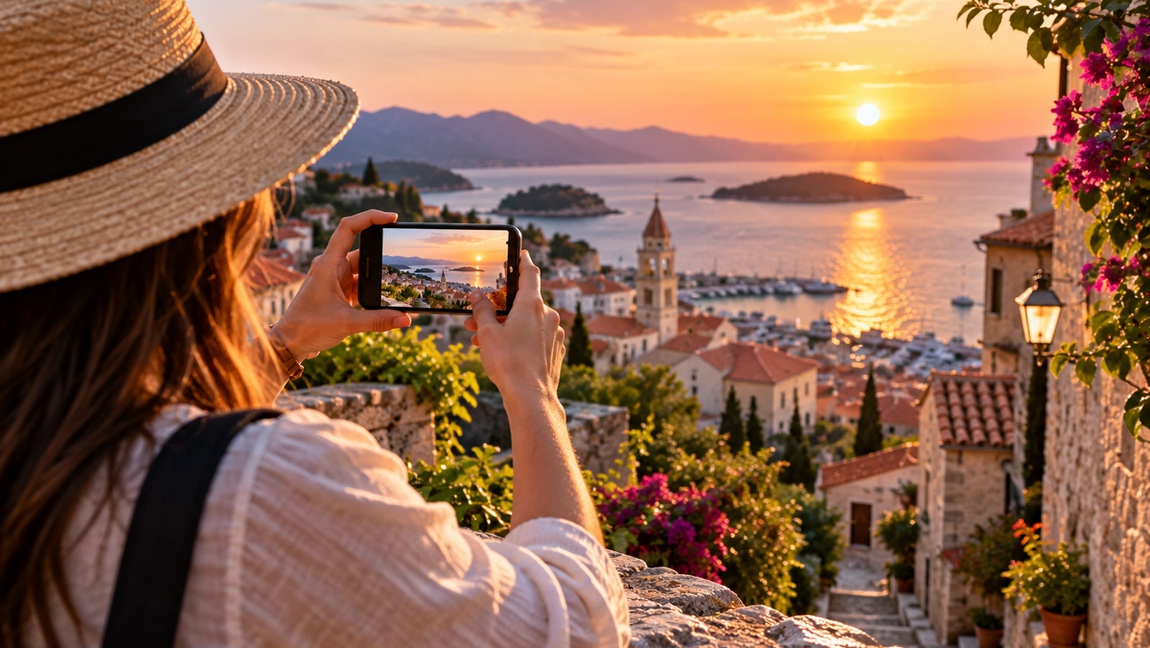
You don’t need an expensive camera to come home with great travel photos.
Modern phones are remarkably capable. They can handle landscapes, portraits, architecture, food, low light, video, and almost every ordinary travel situation without requiring you to understand complicated camera settings.
The bigger difference usually isn’t the equipment.
It’s what you notice before pressing the button.
Better travel photography comes from light, composition, timing, perspective, and knowing what you’re actually trying to remember. Learn a few simple habits and your phone can produce photographs that feel far more intentional without turning your vacation into a permanent photo shoot.
Clean your camera lens
Before learning anything about photography, wipe your phone.
This sounds almost insultingly obvious, but phone camera lenses spend their lives touching fingers, pockets, bags, tables, and everything else.
A tiny layer of grease can make photographs look soft, hazy, or strangely washed out, particularly around bright lights.
Use a clean cloth or even a soft part of your shirt if that’s all you have.
It takes three seconds.
There is no composition technique powerful enough to defeat a fingerprint directly across the lens.
Pay attention to light before anything else
Photography is fundamentally about light.
The same street can look completely ordinary at noon and extraordinary two hours before sunset.
Early morning and late afternoon often produce softer light, longer shadows, and warmer colors. This can make landscapes, buildings, and people much easier to photograph.
Midday light is stronger and can create harsh shadows, particularly on faces. That doesn’t mean you should stop taking photos at noon. Look for shade, interesting contrasts, reflections, or compositions that work with stronger light.
Also notice where the light is coming from.
Move around your subject.
Sometimes taking three steps to the side changes the entire photograph.
Stop putting everything in the center
Centering your subject isn’t wrong.
Sometimes symmetry makes a centered composition perfect.
But if every photograph places the person, building, or mountain directly in the middle, your travel album can start feeling repetitive.
Try using your phone’s grid.
Place important elements around the lines or intersections rather than automatically in the center. Leave space in the direction someone is walking or looking. Put the horizon higher when the foreground is interesting and lower when the sky is the star.
Composition isn’t about obeying rigid rules.
It’s about deciding what deserves attention.
Before taking the photo, ask yourself what you’re actually photographing.
Then make that thing obvious.
Use your feet before using digital zoom
Digital zoom can quickly reduce image quality.
Instead of immediately pinching the screen to zoom, see whether you can physically move closer.
Walk toward the subject.
Change sides of the street.
Find a different viewpoint.
Many modern phones also have multiple camera lenses with different optical focal lengths. Switching between those can produce much better results than heavily digitally zooming into an image.
There are obviously situations where you can’t move closer.
Please do not interpret photography advice as permission to approach cliffs, wildlife, restricted areas, or the edge of someone’s private property.
Sometimes the correct photographic technique is staying exactly where you are.
Take fewer versions of the same photograph
Phones make it incredibly easy to take 47 photographs of one building.
This feels useful while traveling.
Then you return home with 6,000 images and never look at them again.
Take a few variations intentionally.
Try one wide photograph showing the environment. Move closer and photograph a detail. Try a vertical composition. Include a person for scale.
Then continue with your day.
The goal is not to document every possible angle.
You’re traveling, not conducting a forensic investigation.
Include people in your landscapes
Beautiful landscapes often become more powerful when someone appears inside them.
A person can provide scale.
Suddenly the mountain looks enormous because you can see how small someone is beside it. A narrow street feels alive because someone is walking through it. A beach becomes more atmospheric because there’s a single figure near the water.
The person doesn’t always need to face the camera.
Photographs of someone walking, looking at a view, sitting at a café, or exploring a street can feel more natural than endless posed portraits.
Travel photographs become especially valuable years later when they contain the people who actually took the trip.
Don’t come home with 900 photographs of buildings and three photographs of yourself.
Look for layers
Strong photographs often have something happening in the foreground, middle ground, and background.
Imagine photographing a mountain.
You could simply point your phone toward it.
Or you could include flowers, a path, a person, a doorway, a tree, or another object in the foreground.
Suddenly the image has depth.
The viewer’s eye moves through the photograph instead of immediately reaching the mountain and stopping.
This works especially well with landscapes and architecture.
Look for natural frames too.
Doorways, windows, arches, tree branches, and narrow streets can frame the main subject without requiring any editing.
Photograph details, not just landmarks
When people travel, they often photograph only the obvious things.
The Eiffel Tower.
The Colosseum.
The beach.
The mountain.
Take those photographs.
Then look closer.
Photograph the café table where you had breakfast. The handwritten menu. The tiles in the metro station. Your train ticket. The fruit at the market. The hotel balcony. The shoes you destroyed walking 25,000 steps around Rome.
These details often become more emotionally powerful than the landmark photographs.
A famous monument reminds you where you went.
A tiny detail can remind you how the trip actually felt.
Use reflections and unusual perspectives
When everyone is photographing the same landmark, changing your perspective is one of the easiest ways to create something different.
Photograph a building through a café window.
Use a puddle for a reflection.
Shoot through an archway.
Move lower to the ground.
Look upward.
Photograph the shadow rather than the object itself.
You don’t need to make every photograph creatively complicated.
But occasionally asking “Is there another way to see this?” can transform an ordinary image.
Often the better photograph is only a few steps away from the obvious one.
Tap the screen to control focus and brightness
Your phone makes most photographic decisions automatically, but you can still give it instructions.
Tap the part of the screen you want in focus.
Most phones will also allow you to adjust exposure, making the photograph brighter or darker before taking it.
This is particularly useful when photographing sunsets, bright windows, silhouettes, or scenes with strong differences between light and shadow.
Automatic exposure often tries to make everything evenly visible.
Sometimes that’s exactly what you don’t want.
A darker photograph can preserve a dramatic sky.
A brighter exposure can reveal someone’s face.
Take control when the phone guesses incorrectly.
Don’t overuse portrait mode
Portrait mode can create beautiful photographs by separating a person from the background.
It can also produce strange results around hair, glasses, hands, and complicated edges.
Use it when it improves the image, not automatically whenever a person appears.
Sometimes the background is important.
If you’re photographing someone in Kyoto, Marrakech, New York, or the Dolomites, completely blurring the environment may remove the very thing that makes the photograph a travel photograph.
Let the destination participate.
Edit lightly
Editing can improve a photograph enormously.
It can also destroy one.
Start with basic adjustments.
Straighten the horizon. Crop distracting edges. Adjust exposure. Bring back some detail in shadows or highlights. Add a little contrast if the photograph needs it.
Then stop.
Heavy filters, extreme saturation, aggressive sharpening, and artificial-looking skies can quickly make a beautiful destination look less believable.
The goal is usually to make the photograph resemble what the moment felt like.
Not to make the Mediterranean look radioactive.
Put the phone away sometimes
This may be the most important travel photography advice.
Not every beautiful moment needs to become a photograph.
Take the picture.
Then put your phone away.
Watch the sunset without filming the entire thing. Eat the food while it’s hot. Walk through the market without documenting every stall. Look at the person you’re traveling with instead of constantly looking at them through a screen.
Photography should help you remember the trip.
It shouldn’t become the trip.
Photograph the feeling, not just the place
The best travel photographs aren’t necessarily the technically perfect ones.
They’re the ones that return you to a moment.
Maybe the image is slightly crooked.
Maybe someone’s laughing.
Maybe the weather was terrible.
Maybe the street isn’t famous and nobody else would understand why you photographed it.
But you do.
That’s what your phone is exceptionally good at capturing. It’s always with you, ready for the small moments between the landmarks.
Learn to notice good light. Move around. Look for details. Include people. Edit gently.
And remember that you don’t need to prove you visited somewhere.
You just want photographs that, years later, make you feel like you’re there again.