The Mountain Towns Worth Falling in Love With
Mountain towns have a particular kind of magic. Maybe it’s the way mountains make everything else look smaller. Maybe it’s the wooden houses, cold mornings, hiking trails, fireplaces, and cafés where nobody seems particularly interested in rushing you out. Or maybe it’s simply the fact that almost every ordinary activity becomes better when there is an enormous mountain behind it.
By Gabby Marsh on October 9, 2026
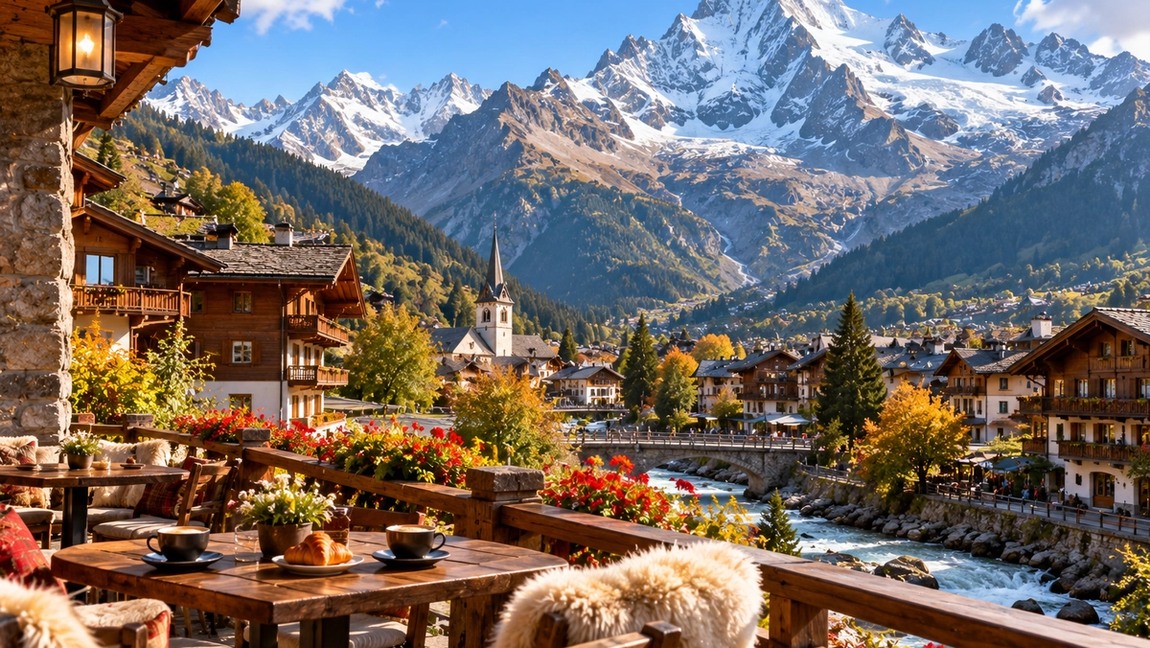
Mountain towns have a particular kind of magic.
Maybe it’s the way mountains make everything else look smaller. Maybe it’s the wooden houses, cold mornings, hiking trails, fireplaces, and cafés where nobody seems particularly interested in rushing you out. Or maybe it’s simply the fact that almost every ordinary activity becomes better when there is an enormous mountain behind it.
The best mountain towns aren’t just bases for skiing or hiking. They’re places you’d happily visit even if you had nothing ambitious planned.
You come for the landscape.
Then you start imagining what it would be like to stay.
Chamonix, France
Chamonix sits beneath Mont Blanc in one of the most dramatic mountain settings in Europe.
Its reputation is closely connected to mountaineering, skiing, and serious outdoor adventure, but you don’t need to be climbing anything to appreciate it.
Cable cars and mountain railways provide access to spectacular viewpoints, while hiking trails spread throughout the surrounding valley. In winter, the area becomes a major destination for snow sports.
The town itself has restaurants, cafés, bakeries, shops, and enough energy to keep it from feeling like somewhere that exists only for tourists to sleep.
But the mountains remain the main event.
You look up constantly.
It’s difficult not to.
Zermatt, Switzerland
Zermatt has one unfair advantage over most mountain towns: the Matterhorn.
The mountain rises above the area in such a distinctive shape that it almost looks designed for postcards.
Zermatt itself is largely car-free, which changes the atmosphere immediately. Electric vehicles move through the streets, but walking remains one of the easiest ways to explore.
In winter, skiing dominates. During warmer months, hiking opens up extraordinary views of the surrounding Alps.
Switzerland isn’t a budget destination, and Zermatt certainly isn’t an exception.
But if you’re going to spend money on a mountain experience, waking up and seeing the Matterhorn outside is a strong argument.
Cortina d’Ampezzo, Italy
The Dolomites don’t look quite like other mountains.
Their pale, jagged peaks rise dramatically above green valleys, creating landscapes that can feel almost unreal in the right evening light.
Cortina d’Ampezzo sits among them.
The town has long been associated with skiing and glamorous winter tourism, but summer may be just as compelling.
Hiking trails, mountain passes, lakes, cable cars, and some of the Dolomites’ most famous landscapes are within reach.
Cortina also gives you something Italy does exceptionally well: the ability to combine serious scenery with very good food.
You can spend the day hiking beneath enormous rock towers and still end it with pasta and wine.
Mountain life could be worse.
Grindelwald, Switzerland
Grindelwald looks like someone built a village specifically to demonstrate what people mean when they say “Swiss Alps.”
Traditional houses spread across green slopes while enormous mountains rise behind them.
The surrounding Jungfrau region offers access to hiking, skiing, cable cars, mountain railways, and some of Switzerland’s most recognizable Alpine scenery.
Grindelwald is popular and heavily developed for tourism, so don’t expect an undiscovered mountain village.
But popularity doesn’t make the mountains less impressive.
Stay long enough to experience the quieter mornings and evenings rather than visiting only during the busiest daytime hours.
Banff, Canada
Banff combines the atmosphere of a mountain town with the scale of the Canadian Rockies.
The town sits inside Banff National Park, surrounded by mountains, forests, lakes, and wildlife.
This means you don’t have to travel far before the landscape becomes extraordinary.
Lake Louise, Moraine Lake, scenic drives, hiking trails, viewpoints, and hot springs make the wider region one of North America’s great mountain destinations.
Banff itself is lively, with restaurants, shops, hotels, and plenty of visitors.
If you want complete isolation, this isn’t it.
If you want spectacular wilderness combined with the convenience of a proper town, Banff gets the balance remarkably right.
Mestia, Georgia
Mestia offers a completely different mountain experience.
Located in Georgia’s Svaneti region, it sits beneath the Caucasus Mountains and is known for its distinctive medieval stone towers.
The landscape is dramatic, but the culture makes the destination even more interesting.
Svaneti has its own traditions, architecture, food, and history, giving a trip here a depth that goes beyond beautiful scenery.
Mestia has become increasingly popular with hikers and adventure travelers, but it still feels considerably less polished than major Alpine resorts.
That’s part of the appeal.
The famous multi-day route from Mestia toward Ushguli takes hikers through some of the region’s most spectacular landscapes and villages.
Hallstatt, Austria
Hallstatt appears on almost every collection of beautiful European villages, and it’s easy to understand why.
The town sits directly beside a lake with mountains rising steeply around it.
The setting is almost absurdly picturesque.
Hallstatt’s popularity can also work against it. Day-trip crowds can transform the tiny village during busy periods.
The solution is time.
Stay overnight if you can.
Early mornings and evenings reveal a much quieter version of the town, when you can walk beside the lake without feeling as though everyone in Europe had the same idea that day.
Hallstatt isn’t somewhere you need a packed itinerary.
The location is the itinerary.
Interlaken, Switzerland
Interlaken isn’t tucked directly beneath one single famous mountain.
Instead, it sits between Lake Thun and Lake Brienz with access to the enormous Alpine landscapes of the Bernese Oberland.
That makes it an excellent base.
From here, travelers can reach places such as Lauterbrunnen, Grindelwald, Mürren, and the Jungfrau region relatively easily.
The town is also famous for adventure activities, including paragliding and other outdoor sports.
Interlaken itself may not be the most charming Swiss village on the list.
Its strength is location.
If you want one base from which to experience several completely different mountain environments, it’s difficult to beat.
San Carlos de Bariloche, Argentina
Bariloche brings an Alpine feeling to Patagonia.
The town sits beside Nahuel Huapi Lake with mountains rising around it, creating a landscape of deep blue water, forests, and snowy peaks.
European architectural influences are visible throughout the area, and the town is famous for chocolate shops that make wandering through the center particularly dangerous if you’re attempting any kind of dietary restraint.
Winter brings skiing.
Warmer months open hiking trails, lakes, scenic drives, kayaking, and cycling.
The surrounding landscape is enormous, so Bariloche works best when you leave enough time to explore beyond the town itself.
Patagonia doesn’t reward rushing.
Queenstown, New Zealand
Queenstown has built an international reputation around adventure.
Bungee jumping, skiing, mountain biking, hiking, jet boating, and countless other activities are available around the town.
But you don’t need to jump from anything to enjoy it.
Queenstown sits beside Lake Wakatipu with the Southern Alps rising around it, giving even an ordinary walk through town an extraordinary background.
The area is also an excellent base for exploring more of New Zealand’s South Island.
It’s energetic, social, and considerably livelier than the stereotypical sleepy mountain village.
For travelers who want mountains without going to bed at 8 p.m., Queenstown delivers.
Theth, Albania
Theth feels like a place the mountains have been hiding.
Located in the Albanian Alps, the village sits in a dramatic valley surrounded by steep peaks.
Improved road access has made Theth considerably easier to reach than it once was, but the landscape still feels wonderfully remote.
The area is known for hiking, waterfalls, traditional stone houses, and access to the famous route between Theth and Valbona.
Accommodation is often provided through guesthouses, adding a more personal dimension than you’d get in a large mountain resort.
Theth doesn’t offer luxury shopping or endless entertainment.
It offers mountains.
Very, very good mountains.
Mountain towns make you slow down
Cities encourage you to keep moving.
There is always another museum, restaurant, neighborhood, monument, or attraction you could be seeing.
Mountain towns work differently.
Sometimes the main activity is sitting somewhere and looking at what is around you.
You hike.
You eat.
You drink something warm.
You watch the light change across the mountains.
And suddenly spending an entire afternoon doing almost nothing doesn’t feel like wasted vacation time.
That’s why the best mountain towns are so easy to fall in love with.
They remind you that a place doesn’t need endless things to do when simply being there already feels like enough.