The Historic Cities Where You Can Actually Feel the Past
Every city has history, but some places make the past unusually difficult to ignore. You don’t experience it only inside museums or behind glass.
By Avishai Sam on October 8, 2026
Every city has history, but some places make the past unusually difficult to ignore. You don’t experience it only inside museums or behind glass. You walk across stones polished by centuries of footsteps, eat beside buildings older than entire countries, pass ancient walls on the way back to your hotel, and suddenly realize that people have been living ordinary lives on the same streets for hundreds or even thousands of years.
The most memorable historic cities aren’t necessarily the ones with the largest collection of monuments. They’re the places where old and new still exist together. People live, work, shop, commute, and drink coffee inside landscapes shaped by civilizations that came long before them. These cities don’t simply preserve history. They continue living inside it.
Rome, Italy
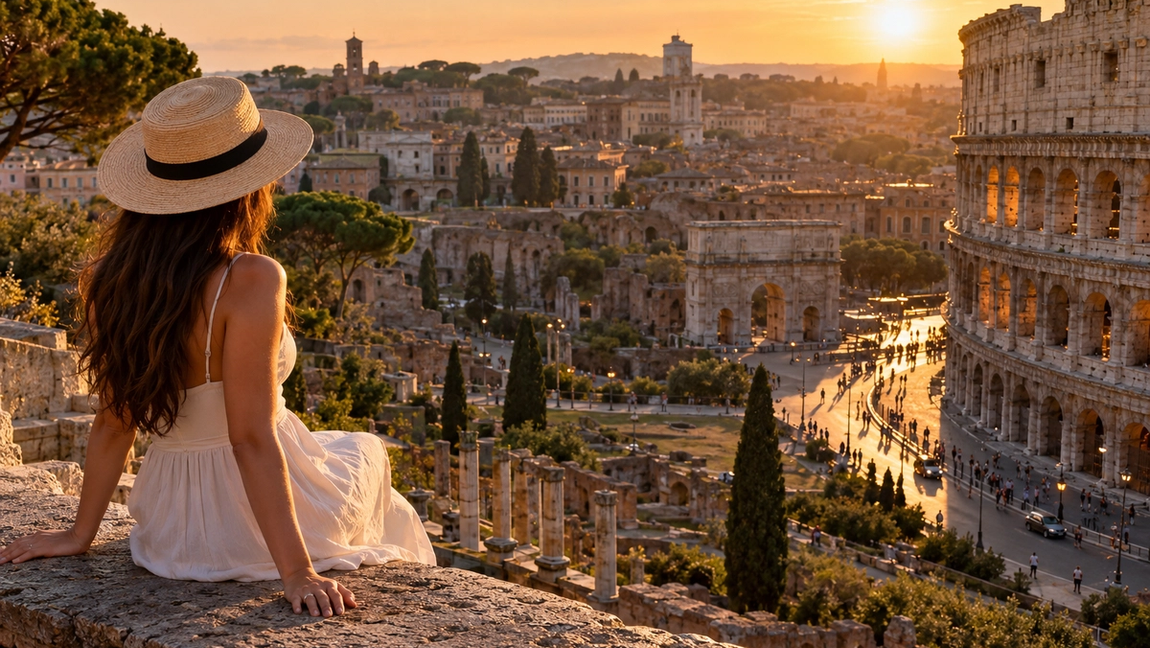
Few cities make historical scale feel as tangible as Rome. Ancient ruins aren’t isolated in one archaeological district. They appear throughout the modern city, sometimes almost casually. You can walk past the Pantheon, cross streets containing fragments of ancient structures, and see the Colosseum rising beside modern traffic.
The Roman Forum gives you the monumental version of the city’s past, but smaller moments can feel just as powerful. Churches have been constructed over ancient buildings. Renaissance palaces stand beside Roman ruins. Medieval streets lead toward Baroque fountains. Every period seems to have built directly on top of another.
Rome’s imperfections actually strengthen the experience. It isn’t a perfectly preserved historical set. It’s a functioning capital that has been continuously altered for centuries, which makes the history feel less like something that ended and more like something the city is still carrying.
Kyoto, Japan
Kyoto offers a different relationship with history. Rather than overwhelming you with massive ancient ruins, much of its historical atmosphere comes from continuity.
The city served as Japan’s imperial capital for more than a thousand years, and its temples, shrines, gardens, traditional wooden houses, and historic districts preserve elements of that long cultural history.
Walk through parts of Gion early in the morning and the modern city can temporarily seem far away. Visit a quiet temple garden and you begin to understand how architecture, nature, religion, and aesthetics became deeply connected in Japanese culture.
Kyoto is still a modern city, of course. Trains, convenience stores, universities, traffic, and contemporary neighborhoods surround its historic sites. That contrast is exactly what makes it interesting. The past hasn’t replaced modern life. It exists alongside it.
Istanbul, Türkiye
Few cities have changed identities as dramatically as Istanbul.
Known historically as Byzantium and Constantinople before becoming Istanbul, the city has been shaped by Roman, Byzantine, Ottoman, and modern Turkish history. It has served as an imperial capital and a meeting point between Europe and Asia for centuries.
You can feel those layers almost immediately. Hagia Sophia reflects multiple chapters of religious and political history. The city’s mosques reshape the skyline created by earlier empires. The Grand Bazaar continues a tradition of commerce stretching back centuries, while ferries cross the Bosphorus between two continents.
Istanbul’s history doesn’t feel neat because it isn’t. Empires rose, religions changed, buildings were repurposed, populations shifted, and the city continually reinvented itself. That’s precisely what makes exploring it so compelling.
Jerusalem
Few cities contain as much history, religious significance, and continuing political complexity within such a small area as Jerusalem.
The Old City contains places sacred to Judaism, Christianity, and Islam, including the Western Wall, the Church of the Holy Sepulchre, and the Haram al-Sharif/Temple Mount. Generations of religious tradition, pilgrimage, conflict, architecture, and everyday life overlap within its walls.
Walking through the Old City’s narrow streets makes the density of that history immediately apparent. Different religious communities, markets, homes, places of worship, and archaeological remains exist extremely close to one another.
Jerusalem’s history is not simply ancient history. Many aspects of the city’s identity, sovereignty, access, archaeology, and sacred sites remain politically contested today. Understanding the city therefore requires more than admiring old buildings. It requires recognizing that different communities may understand the same places through very different historical narratives.
Athens, Greece
Athens gives you one of travel’s great historical experiences: looking up from an ordinary modern street and seeing the Acropolis above you.
Ancient Athens profoundly influenced philosophy, politics, theater, architecture, and other areas of Western intellectual history. Sites such as the Parthenon and Ancient Agora make those textbook subjects suddenly physical.
But Athens becomes more interesting when you stop thinking of it exclusively as an ancient city. It has Byzantine churches, Ottoman-era traces, neoclassical buildings, dense modern neighborhoods, street art, markets, and contemporary Greek culture.
The ancient monuments are extraordinary precisely because modern Athens continues around them. People aren’t living in a museum. They’re living underneath one of history’s most recognizable skylines.
Fez, Morocco
Entering the medina of Fez can feel like stepping into a completely different urban system.
The streets narrow until cars become impossible. Goods move through passageways by hand and other traditional means. Workshops, markets, mosques, schools, homes, bakeries, and courtyards exist within an enormous network of alleys.
The historic medina, Fez el-Bali, developed over many centuries and preserves an urban landscape dramatically different from modern city planning.
This isn’t history presented as a collection of empty buildings. The medina is alive. People work there, shop there, worship there, and live there.
That can also make visiting more intense. It’s easy to get lost, and the density of activity can initially feel overwhelming. But that’s part of what makes Fez extraordinary. You’re not walking through a reconstructed version of the past. You’re walking through a historical urban environment that never stopped functioning.
Dubrovnik, Croatia
Dubrovnik’s stone walls make the city’s history immediately visible.
The old town sits beside the Adriatic, enclosed by fortifications that once protected the maritime Republic of Ragusa. Walking along those walls gives you views over terracotta rooftops, narrow streets, churches, defensive structures, and the sea that shaped the city’s wealth and identity.
Inside the walls, the polished stone streets tell another story. Centuries of movement have literally worn them smooth.
Dubrovnik can become extremely crowded, particularly when cruise ships and summer visitors arrive. Staying overnight changes the experience. Early mornings and evenings allow the old town to feel less like a major attraction and more like an actual historic city.
Its history also isn’t entirely distant. Dubrovnik was shelled during the Croatian War of Independence in the 1990s, adding a much more recent chapter to the story preserved within its walls.
Cairo, Egypt
Cairo offers history on a scale that can be difficult to process.
The nearby pyramids of Giza already take you back thousands of years, but reducing Cairo to the pyramids misses the enormous historical depth of the city itself.
Historic Cairo contains mosques, madrasas, markets, gates, churches, and architecture representing centuries of Islamic and Christian history. The city’s modern streets then surround all of it with the energy of one of Africa’s largest urban areas.
Cairo isn’t quiet history. It’s history surrounded by traffic, voices, shops, food, construction, and millions of people.
That chaos can initially feel overwhelming, but it also prevents the past from becoming sterile. Ancient, medieval, colonial, and contemporary Egypt don’t exist in separate boxes. They overlap.
Prague, Czech Republic
Prague’s historic center can sometimes feel almost unreal.
Gothic church towers rise above old streets. Baroque buildings surround public squares. The medieval astronomical clock still draws crowds in Old Town Square, while Prague Castle watches over the city from across the Vltava River.
But Prague’s history extends well beyond medieval architecture.
The city carries the history of the Habsburg Empire, the First Czechoslovak Republic, Nazi occupation, communist rule, the Prague Spring, the Velvet Revolution, and the creation of the modern Czech Republic.
Understanding those more recent layers makes Prague much more interesting than simply photographing its beautiful buildings.
The city is picturesque, but its history is complicated.
Pompeii, Italy
Pompeii isn’t technically a living historic city in the same sense as Rome or Kyoto, but few places make the ancient world feel so immediate.
The eruption of Mount Vesuvius in 79 CE buried the Roman city, preserving streets, houses, shops, public buildings, artworks, and traces of ordinary life.
That’s what makes Pompeii extraordinary.
You aren’t looking only at temples built for powerful people. You’re walking past bakeries, homes, courtyards, streets, graffiti, and spaces where ordinary people lived.
History suddenly becomes less abstract.
The Romans stop being distant figures from textbooks and become people who ate, worked, complained, decorated their homes, wrote on walls, and walked down streets remarkably similar in purpose to our own.
The best historic cities make time feel strange
Museums can explain history brilliantly. Books can give it context. Archaeologists and historians can reconstruct worlds we could never otherwise understand.
But being somewhere adds another dimension.
You stand inside a building constructed centuries before you were born. You touch a city wall that survived wars, political changes, disasters, and generations of ordinary human life. You walk down a street where millions of people have walked before you.
For a moment, history stops feeling like a sequence of dates.
It becomes physical.
That’s what makes these cities worth visiting. They don’t allow you to imagine the past as something completely separate from the present.
They remind you that the modern world was built directly on top of everything that came before it.