The Difference Between Street Food and Local Food (And Why Both Matter)
Travel advice often treats “street food” and “local food” as if they mean the same thing. They don’t. Street food describes how and where food is sold. Local food describes its relationship to a place, its people, ingredients, traditions, and everyday eating habits.
By Gabby Marsh on October 9, 2026
Travel advice often treats “street food” and “local food” as if they mean the same thing.
They don’t.
Street food describes how and where food is sold. Local food describes its relationship to a place, its people, ingredients, traditions, and everyday eating habits.
Sometimes those categories overlap perfectly. A taco bought from a street stand in Mexico City can be both street food and deeply local food. But a traditional Sunday meal cooked inside someone’s home can be completely local without ever appearing on the street. And a trendy burger sold from a food truck can be street food without having much connection to the region you’re visiting.
Understanding the difference makes traveling for food much more interesting because it encourages you to look beyond the most obvious dishes.
Street food is about accessibility
Street food is generally designed to be relatively quick, convenient, and easy to eat.
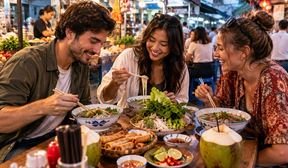
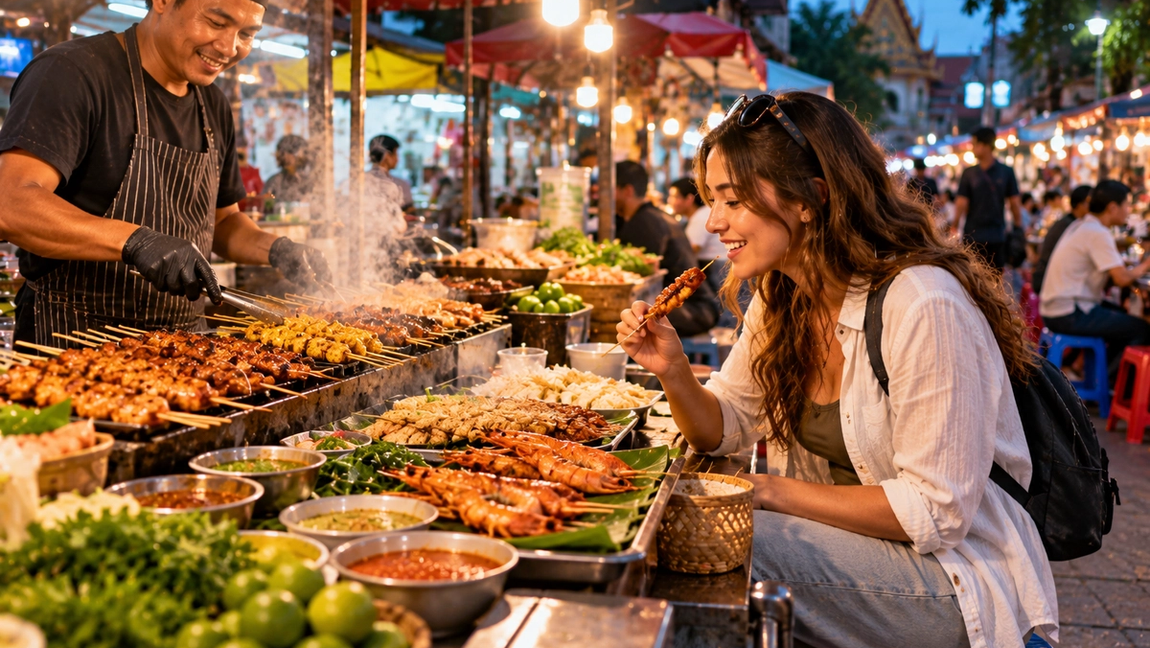
It may come from carts, stalls, kiosks, market stands, small storefronts, or temporary vendors. In some places, people eat standing beside the vendor. In others, plastic tables and chairs turn a section of pavement into an informal dining room.
Street food often develops around the practical needs of city life.
People need breakfast on the way to work. Workers need affordable lunch. Commuters want something quick. People leaving bars want food late at night.
That’s why street food can tell you so much about how a city moves.
You’re not only eating something.
You’re participating, briefly, in the rhythm of everyday life.
Local food is much broader
Local food can appear almost anywhere.
It might be served in someone’s home, a neighborhood restaurant, a bakery, a market, a fine-dining restaurant, a village guesthouse, or a family-run business that has been making the same dish for generations.
What makes it local is its connection to the place.
That connection might come from ingredients grown nearby, traditional cooking methods, religious customs, migration, historical trade routes, climate, agriculture, or simply generations of people continuing to prepare the same foods.
Some local dishes aren’t particularly convenient.
They may require hours of preparation.
They may be associated with weddings, religious holidays, family gatherings, or particular seasons.
You probably won’t find all of them being handed through the window of a food truck.
Some of the world’s most famous foods are both
The overlap between street food and local food produces some extraordinary things.
Tacos in Mexico are an obvious example. So are bánh mì in Vietnam, simit in Türkiye, pani puri in India, and countless grilled, fried, baked, wrapped, or skewered foods around the world.
These dishes often become internationally recognizable because they’re accessible.
Visitors encounter them easily.
They’re visible.
They smell good from several meters away.
They don’t require reservations or knowledge of formal dining etiquette.
You simply see people eating something and decide you want one too.
Street food can therefore be one of the easiest entry points into a local cuisine.
But it should be the beginning of your exploration, not necessarily the end.
Home cooking tells another part of the story
If you only eat street food, you can miss foods that are central to how people actually eat at home.
Think about your own food culture.
The dish your family makes for holidays may never appear at a street stall. The soup you grew up eating may not be considered exciting enough for tourists. A meal associated with grandparents, winter, religious celebrations, or Sunday lunch may be deeply important locally while remaining almost invisible to visitors.
These foods reveal something different.
Street food often shows how people eat when they’re moving through public life.
Home-style food shows how people eat when they sit down.
Both matter.
Restaurants preserve regional traditions too
There’s a tendency to assume that the most “authentic” food must be informal and cheap.
That’s not necessarily true.
Restaurants can play an important role in preserving traditional dishes, regional ingredients, and complicated cooking techniques.
Some foods require equipment, preparation time, or specialist knowledge that makes them impractical as street food.
A restaurant may also take a traditional dish and prepare it with extraordinary attention without removing its connection to the culture.
Price doesn’t automatically determine authenticity.
Neither does furniture.
A plastic chair doesn’t guarantee you’re having a culturally meaningful experience, and a white tablecloth doesn’t automatically mean you’re not.
Pay attention to the food itself and the people preparing it.
Street food changes constantly
Street food isn’t frozen in tradition.
It evolves.
Migration introduces new ingredients and techniques. Younger cooks reinterpret older foods. International dishes get adapted to local tastes. Vendors respond to what people actually want to buy.
That’s why street food can sometimes reveal the present version of a city better than its most traditional restaurants.
A dish doesn’t need to be 300 years old to tell you something about a place.
Maybe it emerged from a particular immigrant community 20 years ago.
Maybe it’s a hybrid of two cuisines.
Maybe it’s something university students started eating late at night.
Culture is constantly being created.
Food shows that process exceptionally well.
Local doesn’t automatically mean traditional
This is another distinction worth making.
A food can be local without being ancient.
Cities change as people move into them.
New communities establish restaurants. Ingredients become available. Tastes shift. Recipes combine.
Over time, foods that once seemed foreign can become completely integrated into a city’s identity.
That’s why searching only for “traditional food” can sometimes give you an incomplete picture of what people currently eat.
Tradition tells you where a food culture came from.
Contemporary local food tells you where it is now.
The most interesting trips make room for both.
Street food teaches you to observe
One of the best ways to choose street food is simply to watch.
Which vendors are busy?
What are people ordering repeatedly?
Does one stall specialize in a single dish?
How quickly does food move through the stand?
You don’t need to understand the language perfectly to learn from the pattern.
A vendor preparing the same thing continuously for a steady stream of customers is usually worth investigating.
You can also watch how people eat the food.
Which sauces do they add?
What do they drink with it?
Do they eat it for breakfast or late at night?
Suddenly you’re learning something that wouldn’t appear on the menu.
Food safety still matters
Being adventurous doesn’t mean ignoring basic judgment.
Street-food hygiene standards and risks vary between destinations, and travelers may be more vulnerable to unfamiliar foodborne pathogens.
Choose vendors that appear to handle food carefully. Busy stalls can be useful because ingredients may turn over quickly. Foods cooked thoroughly and served hot can be sensible choices in places where food safety is a concern.
Drinking water and ice can also require attention depending on the destination.
The goal isn’t to become afraid of street food.
It’s to apply the same basic awareness you’d want anywhere else.
A stomach problem can erase several days of an otherwise excellent trip.
Don’t search for “authenticity” too aggressively
Travelers sometimes become obsessed with finding the most authentic possible meal.
That can create a strange competition.
Suddenly the restaurant isn’t local enough because another one has fewer tourists. The street stall isn’t authentic because it accepts credit cards. A dish is dismissed because the presentation has changed.
Real food cultures aren’t museum exhibits.
People adapt.
Businesses modernize.
Restaurants serve visitors.
Recipes change.
A place can become popular with tourists and still make excellent traditional food.
Instead of asking whether something is perfectly authentic, ask whether it helps you understand how people in that place eat.
That’s usually a much more useful question.
You need both to understand a place
Street food gives you immediacy.
You stand beside people on their lunch breaks, order something you may not know how to pronounce, watch it being prepared, and eat it while the city continues moving around you.
Local food gives you depth.
It introduces you to family traditions, regional ingredients, seasonal dishes, historical influences, celebrations, and the foods people associate with home.
Sometimes one meal gives you both.
Sometimes you need several.
That’s one of the best things about traveling through food.
You don’t need to choose between the famous street stall and the traditional family restaurant.
Eat at both.
The first might show you what the city tastes like when it’s moving.
The second might show you what it tastes like when it comes home.