How to Pack Light Without Sacrificing Anything
You imagine yourself walking effortlessly through the airport with one small bag. Then you remember that you might need another pair of shoes. And a jacket. And something nicer for dinner. And medication. And skincare. And what if it rains? What if it gets unexpectedly cold? What if everyone decides to go somewhere fancy?
By Lila Odin on October 8, 2026
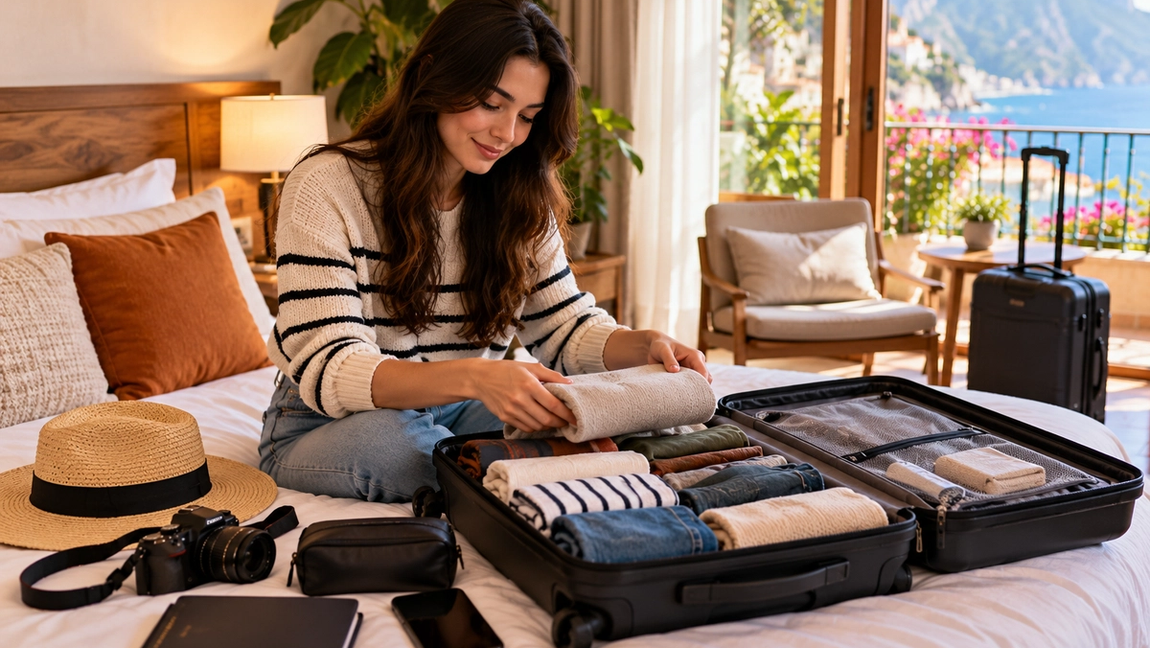
Packing light sounds wonderful until you actually start packing.
You imagine yourself walking effortlessly through the airport with one small bag. Then you remember that you might need another pair of shoes. And a jacket. And something nicer for dinner. And medication. And skincare. And what if it rains? What if it gets unexpectedly cold? What if everyone decides to go somewhere fancy?
Suddenly, your minimalist carry-on weighs approximately the same as a small refrigerator.
The secret to packing light isn’t becoming someone who needs nothing.
It’s learning the difference between bringing what you’ll realistically use and packing for every possible version of the trip.
You don’t need fewer options as much as you need better ones.
Pack for the actual trip
The biggest packing mistake happens before anything enters the suitcase.
We pack for imaginary situations.
Maybe there will be a fancy dinner. Maybe you’ll suddenly start running every morning. Maybe you’ll need three different jackets. Maybe you’ll wear the shoes that have been uncomfortable every single time you’ve worn them at home.
Instead, look at what you’re actually doing.
Check the weather. Think about your accommodation, transportation, activities, and any events with specific dress requirements.
A city weekend requires different things from a hiking trip. A beach holiday requires different things from a work conference.
Packing becomes much easier when every item has a reason for being there.
Build outfits instead of packing individual clothes
A suitcase full of clothes doesn’t necessarily contain many usable outfits.
You may bring ten pieces and discover that half of them only work with one specific combination.
Instead, choose clothes that can easily be worn together.
Neutral or compatible colors make this especially simple. One pair of trousers that works with four tops is more useful than four bottoms that each require a different shirt and shoes.
Think in combinations.
Can the sweater work during the day and over a nicer outfit at night? Can the same trousers work for sightseeing and dinner? Can the jacket go with almost everything you’ve packed?
Versatility reduces luggage without making your wardrobe feel limited.
Stop packing one outfit for every day
You don’t need seven completely different outfits for a seven-day trip.
Clothes can be worn more than once.
Jeans, trousers, jackets, sweaters, and other outer layers rarely need to be replaced after a single wear unless they’re dirty or you’ve been sweating heavily.
For longer trips, doing laundry once can save enormous amounts of space.
A small load halfway through a two-week holiday is often easier than carrying two weeks of clothing across airports, train stations, stairs, and hotel rooms.
The longer the trip becomes, the more useful laundry becomes.
Interestingly, a three-week trip doesn’t necessarily require much more clothing than a one-week trip.
It just requires washing it.
Shoes are the suitcase destroyers
Shoes take up an absurd amount of space.
They’re also heavy.
This makes them one of the easiest places to overpack.
For many trips, two pairs are enough: one comfortable everyday pair and one alternative appropriate for your activities.
That might mean sneakers plus sandals, walking shoes plus something nicer, or hiking shoes plus casual footwear.
Wear the bulkiest pair while traveling.
And be suspicious of any shoe you’re packing for exactly one hypothetical outfit.
If you haven’t comfortably walked in it at home, traveling with it probably won’t improve the relationship.
Use layers instead of bulky clothing
Packing for changing temperatures doesn’t necessarily require several completely different wardrobes.
Layers are much more efficient.
A T-shirt, light sweater, and weather-resistant jacket can be worn separately or combined depending on the conditions.
This gives you more flexibility while taking up less space than multiple heavy outfits.
The same principle works for flights, where temperatures seem to follow their own mysterious climate system.
Keep one useful layer accessible rather than buried at the bottom of your bag.
Shrink your toiletries
Toiletries quietly consume enormous amounts of luggage space.
You probably don’t need full-size bottles of shampoo, conditioner, moisturizer, cleanser, sunscreen, and every other product for a short trip.
Use travel-size containers or bring smaller versions of products you genuinely need.
The same applies to makeup and skincare.
Travel isn’t usually the best time to bring twelve products you occasionally use at home.
Take the routine you actually follow.
If you’re staying somewhere that reliably provides certain basics and you’re comfortable using them, you may not need to pack those products at all.
Don’t confuse organization with packing light
Packing cubes can be excellent for keeping luggage organized.
They do not magically make your belongings weigh less.
In fact, efficient organization can occasionally encourage you to squeeze even more things into your suitcase.
Use packing cubes to separate categories and make unpacking easier, not as permission to bring another seven shirts.
The real space saving comes from deciding what doesn’t need to come.
Organization happens afterward.
Keep the important things with you
Packing light shouldn’t mean taking risks with essentials.
Medication, identification, travel documents, payment methods, necessary electronics, chargers, and other genuinely important items deserve priority.
If you’re flying, keep anything difficult to replace in your carry-on rather than checked luggage.
It’s also useful to think about what could easily be purchased at your destination.
Forgetting toothpaste is inconvenient.
Forgetting prescription medication may be a serious problem.
Not every item deserves the same amount of suitcase anxiety.
Leave some empty space
A perfectly packed suitcase can become extremely annoying on the return journey.
Clothes never seem to fold quite as efficiently after you’ve worn them, and you may buy something while traveling.
Leaving a little space makes repacking easier.
It also keeps your luggage flexible.
You don’t need to treat every available centimeter as a challenge that must be conquered.
Empty space is useful.
Do one final removal round
Once you’ve finished packing, look through everything again.
Ask yourself which items you’re bringing because you’ll use them and which ones you’re bringing because you’re nervous about not having them.
Remove a few of the second category.
You probably don’t need four “just in case” outfits.
You probably don’t need three books for a four-day trip unless reading is the trip.
You probably don’t need an entirely separate wardrobe for the person you imagine becoming on vacation.
Pack for yourself.
Just the slightly more adventurous version.
Light packing is really about freedom
The benefit of packing light isn’t winning some imaginary minimalist competition.
It’s mobility.
You can walk through train stations without fighting your suitcase. You can take public transportation more easily. Stairs become less dramatic. Changing hotels becomes simpler. You’re less worried about luggage restrictions, and unpacking takes minutes instead of turning the room into an explosion of clothing.
Most importantly, you spend less time managing your belongings.
That’s the part people often miss.
Packing light isn’t about sacrificing comfort.
It’s about bringing enough to enjoy the trip without bringing so much that your stuff becomes part of the itinerary.