How to Pack a Bag That Fits Any Airline’s Rules
Packing for a flight would be much easier if every airline agreed on what a carry-on bag actually is. They don’t.
By Alex Slavistki on October 8, 2026
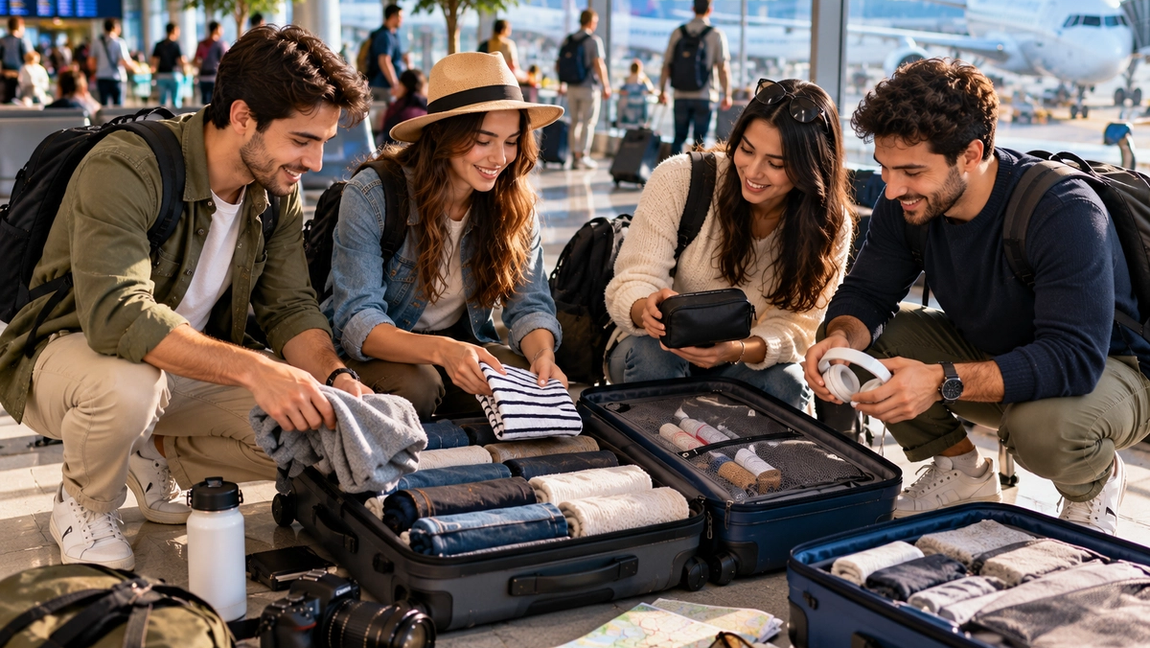
Packing for a flight would be much easier if every airline agreed on what a carry-on bag actually is.
They don’t.
One airline may allow a cabin suitcase and a personal item. Another may include only a small bag under the seat. A suitcase accepted without question on one flight can suddenly become oversized on the next, and weight limits can vary just as much as dimensions.
There isn’t technically one bag guaranteed to fit every airline’s rules. Airlines set their own baggage limits, and those policies can change. But you can pack in a way that gives you a much better chance of moving between different airlines without paying unexpected fees or repacking your belongings at the gate.
The secret isn’t extreme minimalist packing. It’s understanding which limits actually matter.
Check the strictest airline on your itinerary
If you’re flying with more than one airline, don’t pack according to the most generous one.
Pack according to the strictest.
Imagine your first airline allows a 10-kilogram cabin suitcase, while your connecting airline allows only eight kilograms. The fact that your bag was accepted on the first flight won’t necessarily help you on the second.
Check each airline’s official baggage rules before packing. Look at both dimensions and weight, and pay attention to whether your fare includes an overhead cabin bag or only a smaller personal item.
This is especially important with low-cost fares, where baggage allowances may depend on the ticket or additional baggage package you’ve purchased.
The safest assumption is that the smallest allowance on your itinerary is your real allowance.
Understand the difference between a personal item and a carry-on
These terms are sometimes used interchangeably in conversation, but airlines may treat them as completely different categories.
A personal item is generally the smaller bag designed to fit under the seat in front of you. This might be a small backpack, handbag, or laptop bag, depending on the airline’s rules.
A carry-on or cabin bag is usually larger and intended for the overhead compartment.
Some tickets include both. Others include only the personal item.
That distinction can completely change how you pack.
If your fare includes only an under-seat bag, arriving with a standard rolling cabin suitcase may result in an additional charge even if the suitcase would normally qualify as carry-on luggage on another fare.
Always check what your specific ticket includes, not simply what the airline generally allows.
Choose a bag smaller than the maximum
If you frequently fly with different airlines, buying a bag that sits exactly at the maximum dimensions of one carrier can create problems elsewhere.
A slightly smaller bag gives you more flexibility.
Soft-sided backpacks can be particularly useful because they have some ability to compress, provided you don’t overfill them. Structured suitcases are easier to organize and roll through airports, but their dimensions cannot change when you encounter a smaller baggage sizer.
Whichever style you choose, measure the entire bag.
For suitcases, wheels and handles usually count toward the external dimensions. A suitcase body that technically fits may still exceed the limit once its wheels are included.
Measure it yourself rather than relying entirely on a label saying “cabin approved.”
Approved by whom is the important question.
Weight is just as important as size
Travelers often focus so heavily on dimensions that they forget about weight.
A perfectly sized bag can still violate an airline’s rules if it’s too heavy.
Start by checking how much your luggage weighs when empty. Some structured carry-on suitcases can consume a noticeable part of your baggage allowance before you’ve packed anything.
Then weigh the packed bag at home.
A basic luggage scale can be useful if you fly frequently, but an ordinary household scale can also give you a reasonable estimate.
Leave yourself some margin instead of packing exactly to the limit. Your scale and the airline’s scale may not produce precisely the same reading, and you may add something to your bag during the trip.
A bag that weighs 7.8 kilograms for an eight-kilogram limit leaves very little room for surprises.
Pack the heaviest items strategically
The easiest way to reduce baggage weight is often not removing clothing.
It’s looking at your heaviest individual items.
Shoes, laptops, cameras, toiletry bags, books, and heavy clothing can account for a surprisingly large percentage of your total.
Wear your bulkiest practical shoes and heavier outer layer during travel rather than packing them. Choose digital books over physical ones when possible. Transfer toiletries into smaller containers rather than carrying full-size bottles for a short trip.
This doesn’t mean turning yourself into a human luggage rack at the airport.
The goal is simply to avoid using precious baggage allowance for items you could comfortably wear or replace with lighter versions.
Build outfits instead of packing individual clothes
One of the fastest ways to overpack is choosing clothing item by item.
You see a shirt you like and pack it.
Then another.
Then trousers.
Then a dress.
Eventually you have 14 perfectly nice pieces of clothing that barely work together.
Instead, build a small wardrobe where most items can be combined.
Neutral or compatible colors make this easier, but the real principle is versatility. Each top should ideally work with multiple bottoms, and your shoes should work with most of your outfits.
Rewearing clothes is normal while traveling.
Laundry also exists in other countries.
A smaller collection of clothes that works together is much more useful than packing a completely different outfit for every possible moment.
Be careful with liquids
Cabin baggage is subject to aviation security rules as well as airline baggage rules.
Liquid restrictions can differ by airport and security technology, so check the rules for every airport you’re traveling through rather than assuming your departure airport’s procedures apply everywhere.
Where traditional restrictions remain in place, liquids, gels, aerosols, creams, and similar products may need to be in small containers and presented according to security requirements.
The easiest approach is to bring only what you need.
Travel-size toiletries, solid alternatives, or products purchased after arrival can save both space and hassle.
Medication, baby supplies, and certain other necessary liquids may be treated differently, so check the relevant airport or security authority’s guidance when those exceptions apply.
Compression saves space, not weight
Compression cubes can make clothing dramatically smaller.
They cannot make it lighter.
This sounds obvious, yet it’s surprisingly easy to forget when you’ve successfully compressed a mountain of clothes into one tiny rectangle.
If your biggest restriction is physical bag size, compression can be extremely useful.
If your biggest restriction is weight, compression may actually encourage you to pack too much because suddenly everything fits.
Use packing cubes primarily for organization and reasonable space savings.
Your airline’s scale will remain unimpressed by how efficiently you’ve folded everything.
Keep essential items accessible
A well-packed bag isn’t just one that passes the airline’s rules.
It should also work during the journey.
Keep your passport, wallet, phone, boarding documents, medication, charger, and other frequently needed items somewhere accessible.
If your cabin bag is unexpectedly gate-checked, remove valuables, important documents, medication, lithium-battery devices that must remain in the cabin, and anything else you cannot afford to lose access to.
A small personal item can be useful for exactly this reason.
Even when you’re traveling primarily with one larger cabin bag, keeping the essentials together makes airport security, boarding, and the flight itself much easier.
Leave some empty space
Packing your bag until the zipper is fighting for its life creates several problems.
The bag may expand beyond the airline’s dimensions. It becomes difficult to access anything. You have no space for something you buy during the trip. And repacking becomes a complicated puzzle you have to solve every morning.
Leave a little room.
You don’t need to fill every available centimeter simply because it exists.
That empty space is flexibility.
It allows you to remove your jacket, buy a small souvenir, add snacks, or repack quickly without sitting on your suitcase while someone else attempts to close it.
The safest bag is the one with a margin
There is no magical suitcase that can guarantee compliance with every airline in the world.
Rules differ too much.
What you can do is build margin into your packing.
Choose a reasonably compact bag. Check every airline on your itinerary. Pack according to the strictest dimensions and weight allowance. Bring versatile clothing. Keep liquids simple. Weigh the bag before leaving home and don’t pack right up to the limit.
Most importantly, check the rules again before each trip.
The goal isn’t to become an expert in the baggage policies of every airline.
It’s to arrive at the gate knowing that whatever rule they enforce, your bag isn’t going to be the most interesting one in the queue.