How to Order Like a Local Anywhere in the World
You sit down and immediately start wondering whether you’re supposed to wait for someone, wave at the server, order at the counter, scan a QR code, pay first, pay later, leave a tip, avoid leaving a tip, or somehow communicate that you want the dish everyone else is eating three tables away.
By Alex Slavistki on October 9, 2026
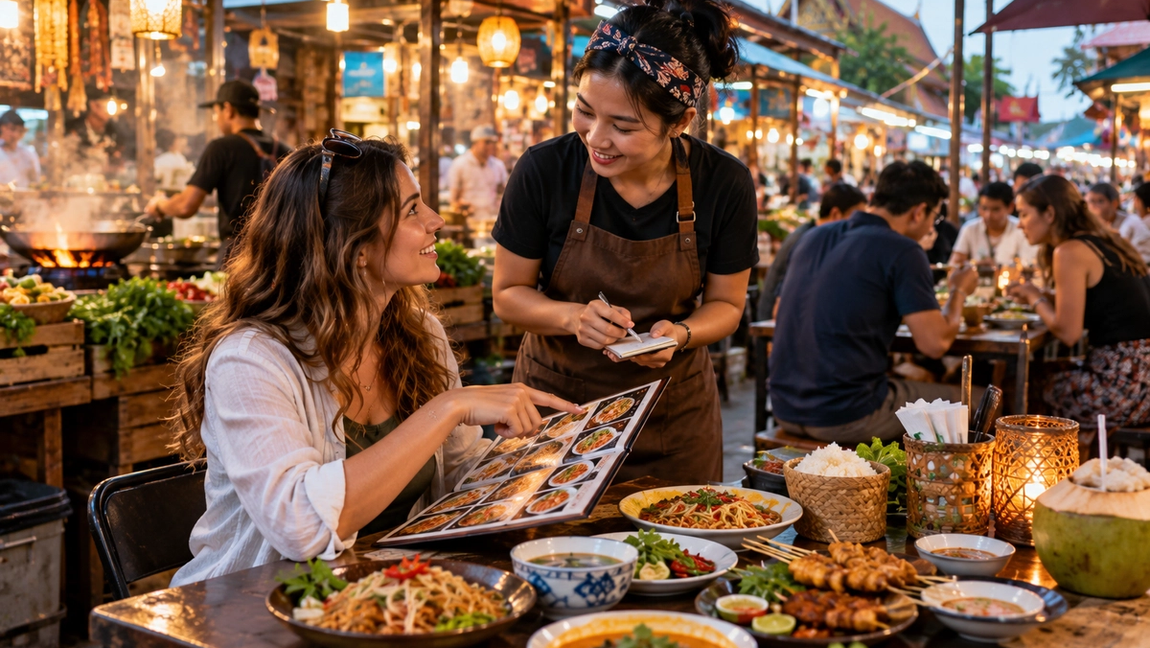
Ordering food in another country can make even confident travelers suddenly forget how restaurants work.
You sit down and immediately start wondering whether you’re supposed to wait for someone, wave at the server, order at the counter, scan a QR code, pay first, pay later, leave a tip, avoid leaving a tip, or somehow communicate that you want the dish everyone else is eating three tables away.
The good news is that ordering like a local doesn’t require speaking the language perfectly or memorizing an entire country’s dining etiquette.
Mostly, it requires paying attention.
The goal isn’t to convince anyone that you live there. It’s to understand the local rhythm well enough to enjoy the meal without expecting every restaurant to operate exactly like the ones back home.
Learn five useful food phrases
You don’t need to become conversationally fluent before dinner.
Learn a few phrases that actually help.
Know how to say hello, please, thank you, and the local equivalent of “I would like.” Learn how to ask for the bill. If you have allergies or dietary restrictions, learn how to communicate those clearly too.
Even when restaurant staff speak English, making a small effort in the local language usually makes the interaction easier.
Pronunciation doesn’t need to be perfect.
Pointing is also allowed.
Human civilization has survived thousands of years partly because someone could point at another person’s dinner and communicate, essentially, “That. I want that.”
Watch what happens before you sit down
Restaurants have different systems, and the easiest way to understand them is to observe.
Do customers wait to be seated or choose their own tables?
Are people ordering at the counter?
Does someone bring menus automatically?
Are diners paying at their tables or walking to the register?
Watch for a minute before doing anything.
This is particularly useful in cafés, bakeries, markets, and casual restaurants where the ordering system may be completely different from what you’re used to.
Instead of immediately asking how everything works, let the room explain itself.
Look at what everyone else is ordering
Menus tell you what a restaurant sells.
Tables tell you what it does well.
If the same dish keeps appearing around the room, investigate.
Maybe the restaurant is famous for one particular specialty. Maybe there’s a lunch special you didn’t understand on the menu. Maybe everyone knows that this is the place for grilled fish, dumplings, noodles, or one specific dessert.
Ask the server what the restaurant is known for.
Better yet, ask what they would order.
You don’t always need to choose the most adventurous thing available.
Sometimes ordering like a local simply means ordering the thing the restaurant has been making exceptionally well for years.
Understand the structure of the meal
Not every culture organizes meals the same way.
In some places, dishes arrive in a clear sequence. Elsewhere, several plates are placed in the middle and shared. Some cuisines expect everyone to order individual meals, while others make far more sense when the table orders collectively.
Even the concept of an appetizer, main course, and dessert isn’t universal.
Before ordering five separate dishes because they’re listed under different headings, look around.
How are other tables eating?
Are plates being shared?
Are portions enormous?
Does everyone receive their own dish?
Understanding the structure prevents both under-ordering and the memorable moment when enough food for eight people arrives at your table of two.
Don’t assume the menu translation tells the whole story
Translated menus are helpful.
They’re also sometimes spectacularly confusing.
A direct translation may describe the ingredients without explaining what the dish actually is. Regional names may have no obvious English equivalent. Automated translations can turn perfectly normal foods into sentences that sound mildly threatening.
When you’re unsure, ask.
A simple question about the main ingredient or preparation method can tell you far more than the translated description.
Photographs can help too, although they shouldn’t be your only guide.
And if the restaurant has no translated menu, your phone’s camera translation can be extremely useful.
Technology has saved many travelers from accidentally ordering three kilograms of something.
Ask what’s good today
Some restaurants are particularly dependent on what’s fresh, seasonal, or available that day.
This is common with seafood, market-driven restaurants, daily specials, and small establishments.
Ask what is particularly good right now.
The answer may steer you away from the dish you planned to order and toward something much better.
Seasonality matters more in some food cultures than travelers realize.
A dish that is famous online may not be the thing locals are excited about during the month you’re visiting.
Let the restaurant tell you what it’s doing well today.
Learn the local meal times
Showing up at the wrong hour can completely change your experience.
Dinner at 6 p.m. may be normal in one country and strangely early in another. Lunch might be quick and functional somewhere else but the major meal of the day in another culture.
Research typical meal times before your trip.
You don’t need to copy them perfectly, but adjusting slightly can help you experience restaurants when they’re actually lively.
It also helps you avoid misinterpreting an empty restaurant.
The place may not be unpopular.
You may simply have arrived two hours before everyone else.
Know the tipping culture before the bill arrives
Tipping customs vary enormously.
In some countries, a substantial tip is expected. In others, service is already included or tipping is modest. Elsewhere, leaving a large American-style tip can be unnecessary or unusual.
Look up the local norm before eating out.
Also check whether a service charge has already been added to the bill.
This prevents that awkward moment at the end of dinner when you’re secretly calculating percentages while trying to determine whether everyone else has already left.
Payment customs differ too.
In some places, servers bring the card machine to the table. In others, you pay at a counter. Splitting bills individually may be completely normal somewhere and inconvenient elsewhere.
A little research saves a lot of confusion.
Be clear about dietary restrictions
This is one area where trying to appear effortlessly local is less important than communicating accurately.
If you have an allergy, religious dietary requirement, or other important restriction, prepare before the meal.
Learn the relevant words in the local language and consider keeping a translated explanation on your phone.
Don’t assume that simply naming the ingredient is enough.
A dish may contain broth, sauces, cooking fats, garnishes, or other ingredients that aren’t obvious from the menu.
When the restriction is medically important, clarity matters much more than adventurousness.
You can explore a cuisine without gambling with your health.
Don’t modify everything automatically
In some restaurant cultures, customizing dishes is completely normal.
In others, it isn’t.
Before requesting five substitutions, consider trying the dish as it was designed.
Local food combinations may initially seem unfamiliar precisely because you haven’t eaten them before.
That unfamiliar sauce, garnish, spice, or side dish may be essential to understanding why the meal works.
Obviously, dietary restrictions are different.
But if the issue is simply preference, occasionally trust the kitchen.
You traveled all this way.
Give the chef a chance.
Stop worrying about looking like a tourist
You are allowed to be unfamiliar with things.
You may pronounce something incorrectly.
You might use the wrong utensil.
You may need to ask what a dish contains.
Someone might immediately know you’re visiting from another country.
None of this matters.
The traveler who politely asks questions and shows genuine interest in the food is usually having a much better experience than the traveler desperately trying to prove they already understand everything.
Ordering like a local isn’t really about performance.
It’s about curiosity.
Pay attention, ask, and then eat
The best restaurant skill you can develop while traveling is observation.
Watch what people order.
Notice how the meal works.
Learn a few useful words.
Ask what the restaurant does best.
Understand local meal times and tipping customs.
Then stop analyzing everything and enjoy your food.
You don’t need to master an entire culture before sitting down for dinner.
You just need enough curiosity to recognize that the rules might be different.
And sometimes the most local thing you can possibly do is point at the plate on the next table, smile at the server, and ask:
“Can I have that?”