How to Actually Plan a Hiking Trip (Beyond the Trailhead)
But the trail itself is only one part of the trip. You also have to figure out how you’re getting there, how long the hike will realistically take, what the weather might do, where you’ll sleep, how much water you’ll need, whether permits are required, and what happens if something goes wrong.
By Moran Sapir on October 8, 2026
Planning a hiking trip can look deceptively simple.
Find a beautiful trail, download the route, pack some snacks, and start walking.
But the trail itself is only one part of the trip. You also have to figure out how you’re getting there, how long the hike will realistically take, what the weather might do, where you’ll sleep, how much water you’ll need, whether permits are required, and what happens if something goes wrong.
The best hiking trips usually aren’t the most spontaneous ones. They’re the ones where enough planning happened beforehand that you can actually relax once your boots hit the trail.
Choose a hike based on reality, not the photos
A spectacular viewpoint tells you almost nothing about how difficult it is to reach.
Before choosing a trail, look at the total distance, elevation gain, terrain, altitude, estimated duration, and technical difficulty. A 10-kilometer walk on relatively flat ground is very different from 10 kilometers involving steep climbing and significant elevation gain.
Your own experience matters too.
If your longest recent walk was an easy two-hour hike, a demanding eight-hour mountain route probably shouldn’t be your next step simply because the photographs look incredible.
Consider the entire group as well. A hike should generally be planned around the abilities of the least experienced person rather than the strongest.
The goal isn’t to prove that you can survive the route.
It’s to enjoy it safely.
Research more than one description of the trail
Don’t rely on a single hiking app or blog post.
Look at official park or trail information when available, recent trail reports, maps, and experiences from hikers who completed the route recently. Conditions can change because of snow, flooding, landslides, fires, damaged bridges, construction, or seasonal closures.
Pay particular attention to when the information was published.
A review describing perfect conditions in August may tell you very little about the same trail in April.
You should also know whether the route is a loop, an out-and-back trail, or a point-to-point hike. Point-to-point routes can create transportation problems if you reach the end and discover your car is 15 kilometers away.
Understand how you’re getting both to the beginning and home from the end.
Treat the weather as part of the route
Weather matters everywhere, but mountains can make it especially unpredictable.
Check the forecast before leaving, then check it again close to departure. Look beyond the temperature. Wind, rain, thunderstorms, visibility, snow, and extreme heat can completely change the difficulty of a hike.
Remember that conditions at the trailhead may not match conditions higher up.
A comfortable morning in a valley can become cold and windy at elevation.
This is why layers are so useful. Clothing you can add or remove gives you more flexibility than one heavy outfit.
Most importantly, don’t become emotionally attached to completing a particular hike.
Turning around because conditions have deteriorated isn’t failure.
It’s good judgment.
Calculate time more conservatively than you think
A hiking app might estimate that a route takes four hours.
That doesn’t necessarily mean your trip will take four hours.
You’ll stop for food. Someone will need a bathroom break. You’ll take photographs. You may walk more slowly uphill than expected. You might take the wrong turn and need to backtrack.
Build extra time into the plan.
Daylight matters too. Know roughly when it gets dark and aim to finish with a comfortable margin rather than timing your arrival for the final minutes of daylight.
Starting earlier often makes hiking dramatically easier.
You get more time, cooler temperatures in warm weather, and flexibility if the day doesn’t go according to plan.
Plan your food and water before you’re hungry
Hiking uses more energy than an ordinary day, particularly when you’re climbing.
Bring food that’s easy to carry and eat, such as sandwiches, fruit, nuts, energy bars, or other calorie-dense snacks you know your body handles well.
Water requires more thought.
How much you need depends on the weather, distance, intensity, altitude, and individual person. Don’t assume you’ll simply find water along the route.
If you plan to refill from natural water sources, research whether reliable sources exist and use an appropriate filtration or purification method. Streams can be contaminated even when the water looks perfectly clean.
For longer or more remote hikes, carrying extra food and water gives you a useful safety margin if the trip takes longer than expected.
Know exactly where you’re going
Phone navigation has made hiking easier, but it has also created a dangerous assumption: that your phone will always work.
Cellular coverage can disappear quickly in remote areas.
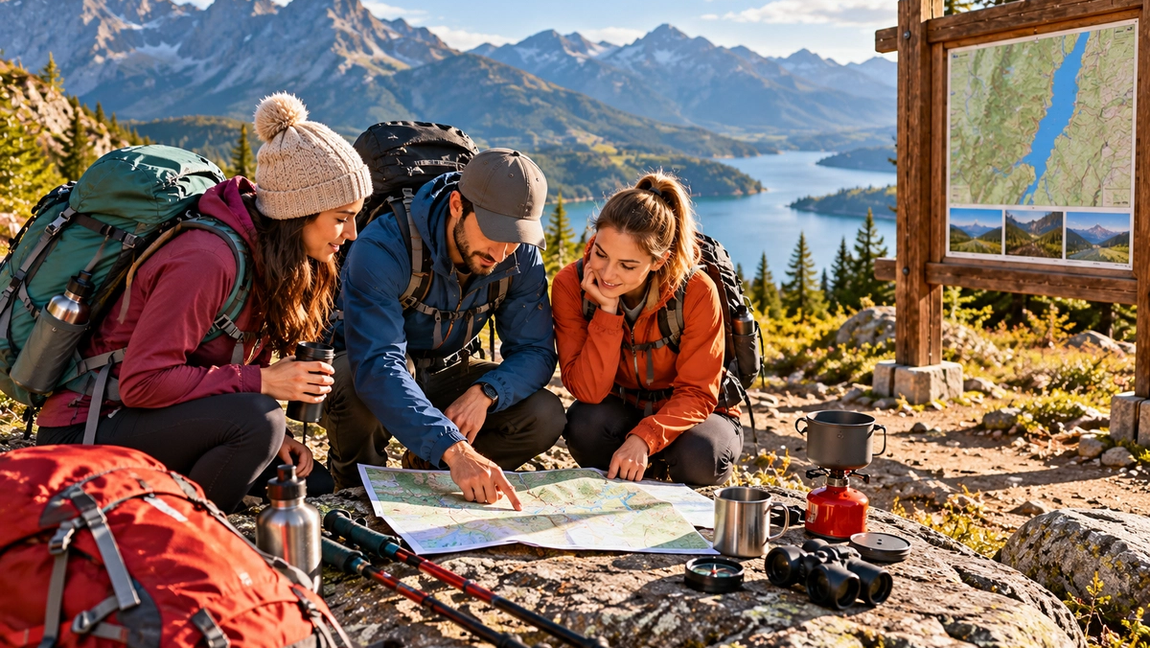
Download your map for offline use before leaving. Make sure your phone is charged, and consider carrying a portable battery on longer trips.
For remote or complicated routes, knowing how to use a proper map and compass remains valuable. Depending on the location and level of risk, a satellite communication device can also provide an additional layer of security.
Navigation isn’t only about finding the destination.
It’s about being able to find your way back when the trail suddenly stops looking obvious.
Pack for the problem you don’t expect
Most hiking gear won’t be used on every trip.
That’s the point.
A small first-aid kit feels unnecessary until someone gets hurt. A headlamp seems excessive on a daytime hike until you’re still walking after sunset. An extra layer feels annoying in your backpack until the temperature suddenly drops.
Sun protection, weather protection, basic first aid, navigation, food, water, and a light source should be considered according to the route and conditions.
Footwear matters as well.
You don’t necessarily need expensive hiking boots for every trail, but you do need shoes appropriate for the terrain that you’ve already worn enough to trust.
A long hike is a terrible place to discover that your new shoes destroy your feet.
Tell someone your actual plan
If you’re hiking somewhere remote, someone who isn’t joining you should know where you’re going.
Tell them the trail or route, who you’re with, when you’re starting, and approximately when you expect to return.
More importantly, tell them what to do if they don’t hear from you.
This takes less than a minute and can become extremely important if something goes wrong.
If your plans change, update them when possible.
Plan what happens after the hike too
The trip doesn’t end when you reach the trailhead again.
Think about where you’ll eat, where you’re sleeping, whether you need transportation, and how far you still have to drive.
After several hours of hiking, a three-hour drive home may feel much harder than it did when you planned the trip from your sofa.
For multi-day trips, accommodation location matters. Staying closer to the trail can allow an earlier start and eliminate stressful driving before or after a demanding day.
Even something as simple as leaving dry clothes and comfortable shoes in the car can dramatically improve the end of a wet hike.
Leave enough room for the trip to change
Good hiking plans aren’t rigid.
They’re plans with alternatives.
Know where you can turn around. Have a shorter route available if the weather changes. Understand which parts of the trip are optional and which are essential.
The mountain doesn’t care that you’ve traveled six hours, booked a hotel, or spent months imagining the summit.
Sometimes the smartest hiking decision is continuing.
Sometimes it’s turning around.
Planning gives you enough information to know the difference.
Because a great hiking trip isn’t just about reaching the viewpoint.
It’s about getting there, enjoying it, and getting home safely enough to start planning the next one.